
The End?
To begin with…. an emphatic NO!, Intel is not over. Not even close, but the once unquestioned king of CPUs is struggling a bit as of late. The behemoth has had a rough few weeks and could potentially lose significant market share to AMD in light of recent events. We’ll look later at what went wrong and why it’s not the end. Starting with production issues and an admission of micro-code issues with overvoltage that has left questions on their chip quality covered here: Intel Addresses Instability Issues
The Register has a great article detailing some of these issues (link below) so I will just touch on the highlights of Intel CEO Pat Selsinger mentioning the “death march” with chip yields and getting production to 2nm technology. And also there is reminder of the floating point division problems with the Pentium processors our favorite song writer Weird Al, sang about back when they came out in 1994. Further Intel passed on being the company to provide the hardware for Intel and their market capitalization of $81 billion seems impressive, until you compare it to Nvidia’s $2.5 Trillion. (That’s a lot of zeros)
To add to fuel to the fire, Intel announced last week that it is laying off 15% of their entire workforce, which can’t be very reassuring to the remaining 85% that at least for now assume they have stable jobs.
“Our revenues have not grown as expected — and we’ve yet to fully benefit from powerful trends, like AI. Our costs are too high, our margins are too low.” – Intel CEO Pat Selsinger
Intel is hoping to cut costs as part of its plan to reduce $10 billion dollars, as it struggles to maintain its once lofty market dominance. AI and mobile chips have left Intel out for the most part and seen Nvidia, Qualcomm and Texas Instruments become leaders in AI and mobile chips.
Market Reactions:
Let’s look at how recent events have affected the share price of Intel and other major chip manufacturers, especially their main direct competitor AMD. Below we’ll look at the stock market prices before and after the recent troubles and layoffs, and a year and five year view on the major chip manufacturers growth compared to its competition.
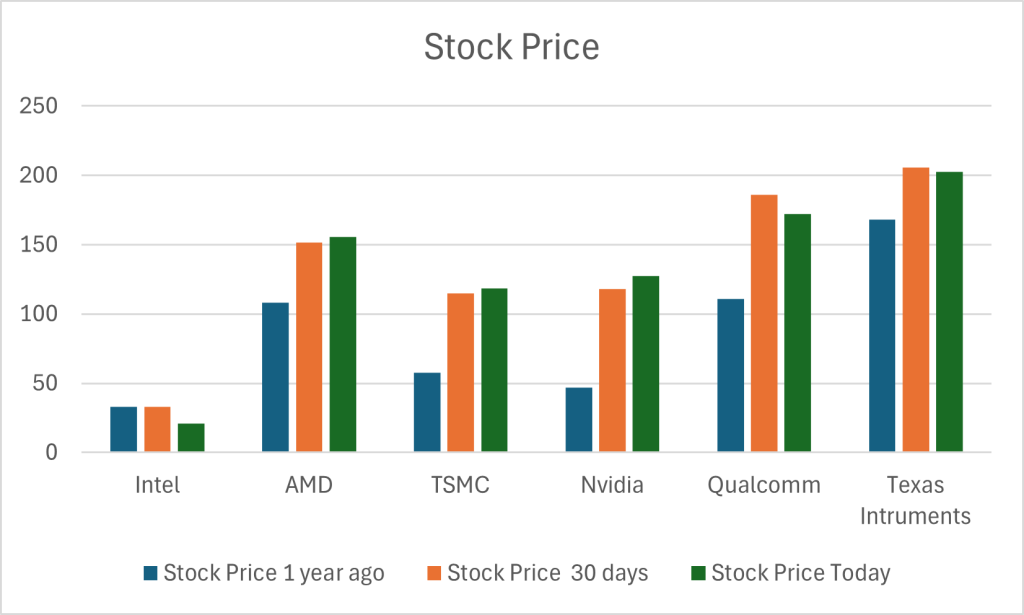
Looking at market capitalization we can see that Intel is no longer the behemoth it once was, and pales really in comparison to competitors like TSMC and Nvidia.

Market Share and Projections:
So…. what is the current market share for Intel and AMD? And what projections can we see from recent events? We will look at CPU and GPU share trends, and projections possible, this is however all conjecture on projections. History has taught us, AMD as the underdog has show some amazing leaps in innovation to keep up and compete, but Intel has also always seemed to have an Ace up their sleeve and just when it looks like AMD has gotten the better of AMD, Intel always seems to pull that Ace card, “oh wait, we also have this we are about to release”, so don’t count Intel out as the big guns leader in CPU’s just yet. Comparatively companies like Broadcom and Samsung, along with the others mentioned above are responsible for a much larger portion of the semiconductor marketplace than Intel.
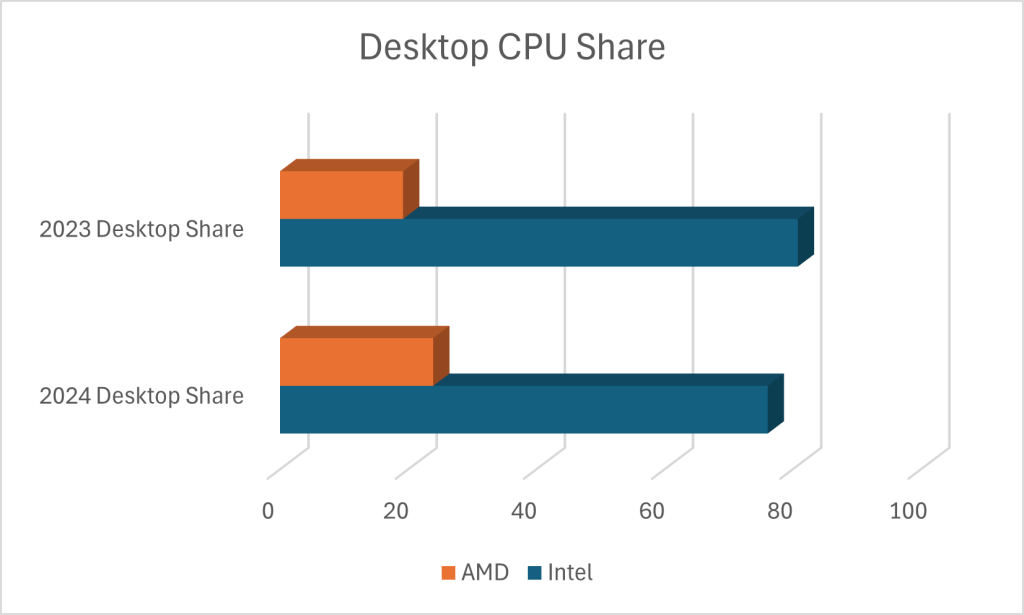
AMD is making gains on Intel moving up from 19.2% last year to 23.9%. It will remain to be seen whether Intel can maintain its dominance or lose significant ground to AMD’s newest desktop offerings.
Public Reaction and Conjectures:
So public reaction seems uniform that Intel F’d up in a few ways. And these are failures straight out public relations 101:
- Not maintaining a level of quality excellence. Production issues should have been addressed and resolved and the cause investigated fully Though employee comments are they were resolved, the public is left wondering why the existed in the first place, and if they are part of the current microcode issues.
- Not admitting to the mistakes and letting the public know they were aware of and working on a solution immediately. People in Intel knew there was a problem as soon as it surfaced, and it took awhile for an intel employee to publicly address this in a very buried forum post, and not a media press release level addressing of the issue.
- Returns and Warrantees are still an unknown mess. Are 13th and 14th generation CPU from Intel reliable? If they fail under normal use will Intel replace them? This is still a very grey area for customers whom have already purchased a very expensive CPU or are considering doing so. Intel needs to determine if there is a issue with possible failures or longevity for their product and stand by it.
Why (Or How) Intel Will Definitely Survive this:
It is possible it will only get worse for Intel. However, I do think if they follow some simple steps they are likely already doing, and just their current overwhelming clout, will see them continuing to be the dominate CPU producer for home and business computing.
- Assure the Customer Base. Address CPU issues and ensure that customers both current and prospective are assured that if there are manufacturing or microcode problems, they will be resolved without the customer being left holding the bag.
- History and Warchest. Intel still can rely on a history of an old business adage “No one every got fired for buying”…. it was “IBM” back in the day, but Microsoft, Intel and Dell have all warranted this same business mid-level management guarantee over the years. Not exactly always true, and times change, you could get fired pretty quickly for suggesting IBM brand desktops as the solution nowadays. (Lenovo is not IBM) Intel also has a very rich portfolio of patents, and despite layoffs, a very massive and talented workforce. They cannot afford to rest on laurels at this point, but they also are very much ahead of their competitors with this rich history.
- Gaudi 3? Intel claims to have an AI accelerator that can beat competitor Nvidia’s H1000 processor, how true is this? Remains to be seen.
8/20/2024
By Greg Cunningham
References:
https://www.intel.com/content/www/us/en/products/details/processors/core/i9.html
https://www.theregister.com/2024/08/09/opinion_column_intel
https://www.macrotrends.net/stocks/charts/AMD/amd/market-cap


